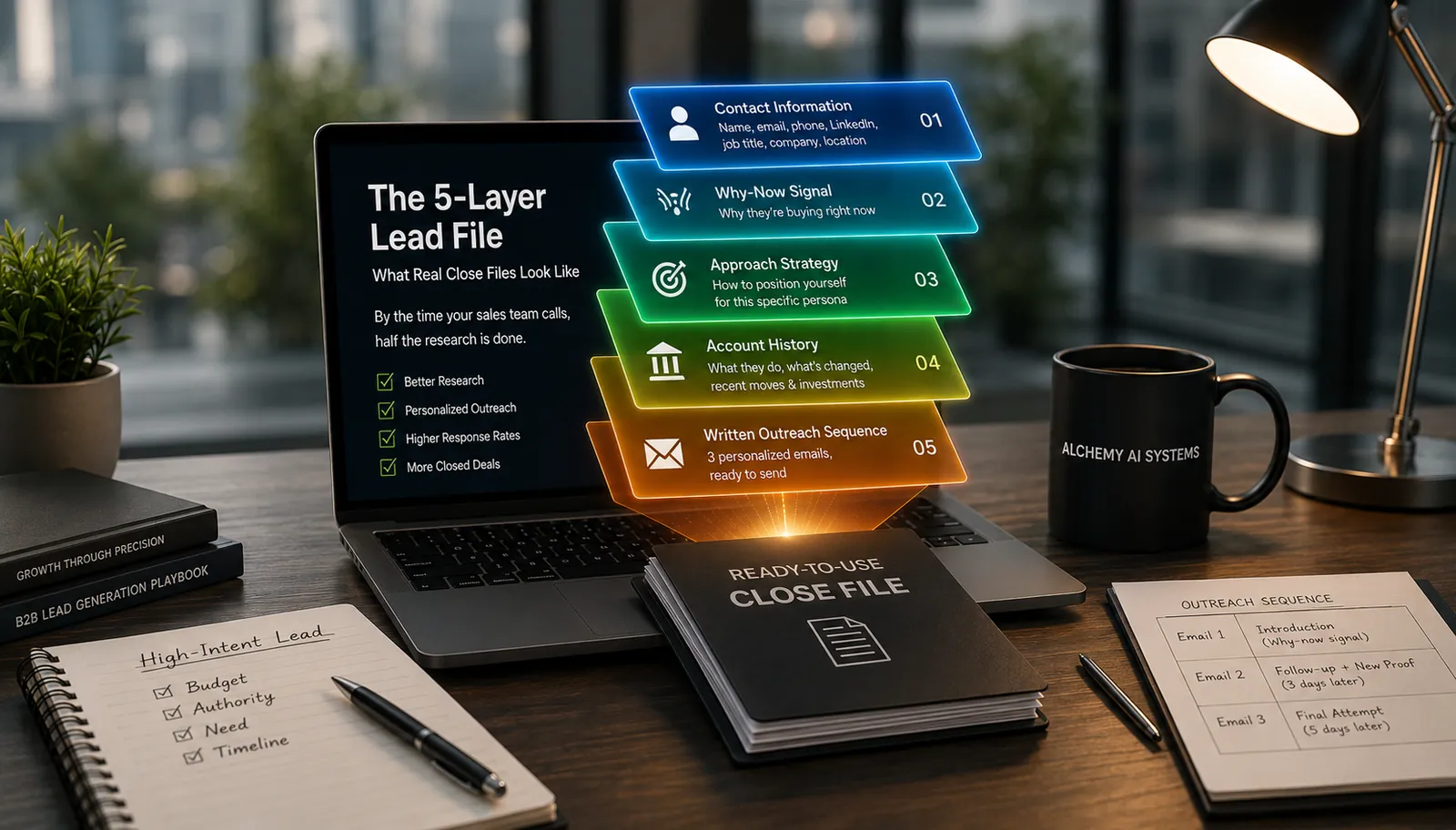
Most lead gen is broken. You get a list of 500 names and a promise that "they're all interested." Real lead gen looks different. Every lead is researched. Every contact comes with context. Every outreach is personalized. We call this a Close File.
Here's what's in it:
- Contact information (name, email, phone, LinkedIn)
- Why-now signal (why they're buying right now)
- Approach strategy (how to position yourself)
- Account history (what they've done, what's changed)
- Written outreach sequence (3 emails, ready to send)
By the time your sales team calls, half the research is done.
Layer 1: Contact Information
Not just email. We want full name, email, phone number, LinkedIn profile, job title, company, and location. Why all this? Because your sales team needs options — if email bounces, they call; if LinkedIn is private, they try email first.
This level of detail takes time to research. Most agencies skip it. That's why most leads don't convert.
Layer 2: Why-Now Signal
This is the key to high response rates. "Why now" means: why would they be interested in your service right now? Recent hiring, a new facility opening, funding raised, a recent project completion, equipment failure, a staff change, or a new project announcement.
Without a why-now signal, your outreach is generic. With one, it's contextual — and response rate jumps from 2% to 25%+.
Layer 3: Approach Strategy
How do you position yourself to this specific person? A plant manager cares about uptime and cost per kilowatt. A finance manager cares about capex vs. opex and payback period. An EPC contractor cares about timelines and cost certainty. A factory owner cares about ROI and growth enablement.
In the Close File, we specify the exact positioning for each persona — so your sales team doesn't pitch the same thing to everyone.
Layer 4: Account History
What does this company do? What's their trajectory? Recent investments, product launches, supplier changes, or geographic expansion all signal readiness to buy. This context helps your sales team understand the account, not just the individual.
Layer 5: Written Outreach Sequence
By the time your team reaches out, 80% of the research is done. We write 3 emails, ready to send: an introduction referencing the why-now signal, a follow-up with new proof 3 days later, and a final, low-pressure attempt 5 days after that.
Real Example: Ultra Power Controls Close File
Lead #47 (the ₹1Cr client): a plant manager at a manufacturing facility in Coimbatore. The why-now signal was a newly announced facility expansion requiring 150,000 sq ft of electrification, with an 8-year-old vendor relationship ripe for switching.
The approach: position as end-to-end electrical execution with a 25-year uptime guarantee and local Coimbatore presence. The sequence went from silence, to interest on email 2, to a scheduled call on email 3 — and from first contact to signed contract took 8 weeks.
Without the Close File structure, this deal never happens. It's too easy to dismiss a cold email. But with the right research, the right angle, and the right sequence, a cold lead can become a ₹1Cr contract.
How to Build Your Own Close Files
- Identify your high-intent buyer — who actually has budget and authority?
- Find why-now signals — hiring, funding, expansions, projects.
- Define your approach per persona — what matters to this person?
- Research their account — trajectory, recent moves, industry context.
- Write your 3-email sequence — with specific references, not generic copy.
The Bottom Line
Cold outreach doesn't have to feel cold if you do the research first. A Close File is the difference between a 2% response rate and a 25%+ response rate — between a discount-driven conversation and a value conversation, between luck and predictability.